



Emotional consumption drives spending among China's youth
Emotional consumption — consumer behavior driven by emotional needs and psychological comfort — has recently gained wider public recognition in China, especially among young consumers.
Emotional consumption has become a major factor behind youth spending today, including the Labubu toy craze, concert tickets that require luck to secure, blind box and trendy toy stores, emerging IP collaborations and pop-up shops, and cultural markets. It also extends to experiences like spontaneous trips, dining in traditional attire and dressing up for travel photos.
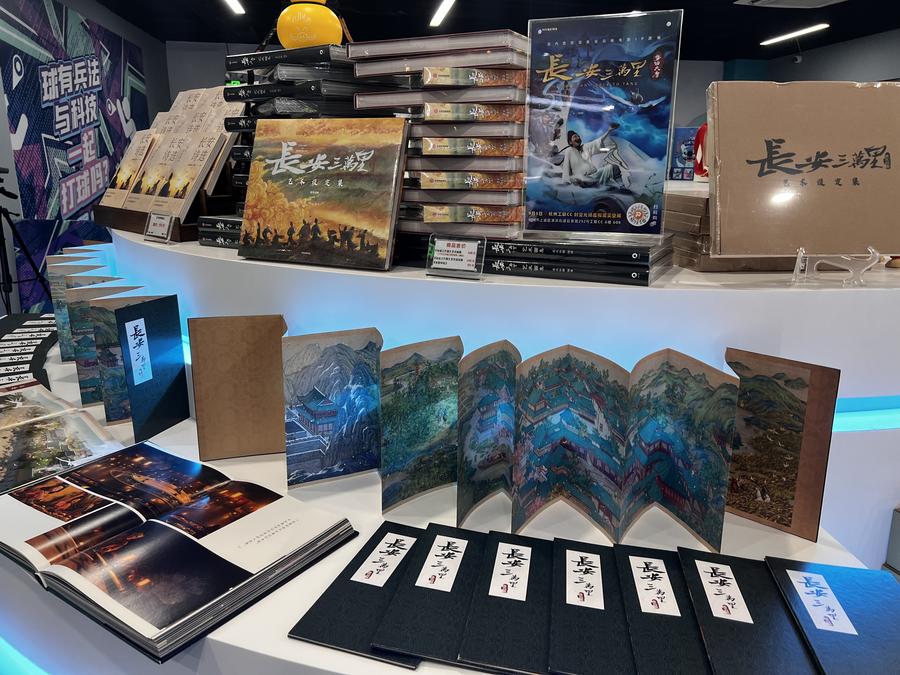
This photo taken on Nov. 14, 2025 shows creative products themed on "Chang An" displayed at a shop of Times Light Field in Gonglian City Center in Hangzhou, east China's Zhejiang Province. (Xinhua/Ji Hang)
The surge in emotional consumption reflects a shift from functionality to psychological fulfillment. People no longer focus solely on functional value but emphasize the emotional experience — stress relief, pleasure, a sense of achievement, simple joys or companionship. This type of consumption meets the emotional needs created by a fast-paced lifestyle. By offering affordable ways to find immediate emotional value, it has become a key way for young people to manage stress and enrich their inner lives.
Among forms of emotional consumption, experiential consumption is a category in which young people are increasingly willing to invest energy and money.
Song, a musical theater fan, recently attended her eighth show of the year. She was selected by a performer to sing a duet during the musical "Six," making the performance "an unforgettable experience" and "the best gift."
"It wasn't just the amazing show and interaction," Song said. "Being chosen to sing in front of more than a thousand people made staying up all night for a ticket worthwhile."
For Wang, a 29-year-old office worker, pottery workshops offer a respite when work pressure builds. She attends a session once a week.
"Two hours of kneading clay invigorates my mind — it's healing," she said. Sometimes she doesn't even take her work home. "I want the process; the result doesn't matter."
This pattern, known as experiential consumption, centers on participation. Its value lies in the emotional satisfaction derived from the process itself. Consumers prioritize experience and personal fulfillment, making it a defining trend in today's market.
According to a 2025 report on emotional consumption among Gen Z (born between 1995 and 2009), jointly released by the Shanghai Youth & Children Research Center and Soul App, over 90 percent of respondents prioritize "emotional value."
The report found that 46.8 percent see emotional consumption as a remedy for "stress and anxiety," 43.1 percent feel it "makes them needed and seen," and 32.8 percent say it gives them "motivation." Many young people also engage in experiential consumption simply to please themselves.
As the emotional economy expands, experience-based consumption is no longer just about stress relief but has become a way for young people to find satisfaction, enjoy small joys, and maintain social bonds.
"We have a common hobby of attending concerts of the rock band Mayday. Going alone is dull, so I find companions online," said 30-year-old Wang, whose passion for her idols remains strong. Even if friends lack the energy or time, online communities provide like-minded partners. Fans from the same city carpool or share hotels to attend concerts together, creating experiences as meaningful as traveling with close friends.
This "immersive emotional satisfaction" is becoming a new social currency among the young. On the popular Chinese social media platform Xiaohongshu, a topic on "escape room stress relief" in Beijing has surpassed 80 million views.
For young people, emotional consumption has become a key outlet for stress relief, self-expression and happiness, providing moments of calm and contentment amid hectic lives.
With Gen Z becoming the primary consumer group, spending on emotion, memories and satisfaction is no longer niche but a core driver of entertainment consumption. The report shows 56.3 percent of young people are willing to spend money on products that bring them happiness and emotional comfort, up 16.2 percentage points from 2024.
This shift in consumption habits reflects a pursuit of a better life and injects new vitality into consumer markets, prompting enterprises to enhance the emotional and cultural value of their products.
The rise of experiential consumption is reshaping Beijing's commercial landscape. In the city's shopping malls, cinemas, video game arcades and claw machines are now commonplace. Some malls also offer escape rooms, handicraft studios and small theaters, creating new leisure spaces for people.
During the summer vacation, Joy City mall in Beijing's Chaoyang district launched over 20 IP-themed activities featuring franchises such as Inuyasha, Pokémon, One Piece and Honor of Kings. The events pushed summer foot traffic above 5.8 million, up 8.7 percent year on year. Sales reached 860 million yuan ($121 million), up 6.1 percent year on year, with July and August visits hitting new highs. More commercial entities now recognize that emotional value drives traffic.
More notably, experiential consumption is extending beyond malls into public spaces, becoming a new highlight of urban commerce. In September, Daji Alley in Beijing's Xicheng district launched a large-scale immersive puzzle event, turning the street into an interactive venue. During the National Day holiday in early October, the Jazz & Art Life Festival at Chaoyang Park integrated music, art and daily life with 32 shows across eight days.
Photos



Related Stories
- China's economic planner issues guideline to boost new energy consumption
- Pocket-size bag charms sway into style in China
- China rolls out measures to boost inbound consumption
- Trend of ‘migratory bird’ lifestyle highlights retirees’ rising role in China’s consumption
- China to improve policies on duty-free shops to boost consumption
- East China grassroots soccer league scores big on consumption
- Thriving new consumer trends fuel China's economic vitality
- China lays out pitch to lure world's consumers
- E-commerce, logistics companies busy preparing for "Double Eleven" shopping festival
- China Post strives to ensure package delivery for "Double Eleven" online shopping festival
- News Analysis: China's multi-trillion-yuan consumption sectors in the making
- "Double 11" shopping bonanza ignites fresh surge in consumer spending
- E-commerce, logistics companies busy with "Double Eleven" shopping festival across China
- China's sporting passion beats to new economic pulse
- Trade-in program likely to continue next year
- Gen Z consumers fill shopping carts with future getaways at 'Double 11' shopping festival
- China releases action plan to further boost consumption
- How emotion-driven spending fuels China's consumer potential
- China to cultivate 3 consumption sectors worth 1 trillion yuan each by 2027
- China eyes improved supply-demand alignment to unlock consumption potential
Copyright © 2025 People's Daily Online. All Rights Reserved.
 久久99热播精品免费