

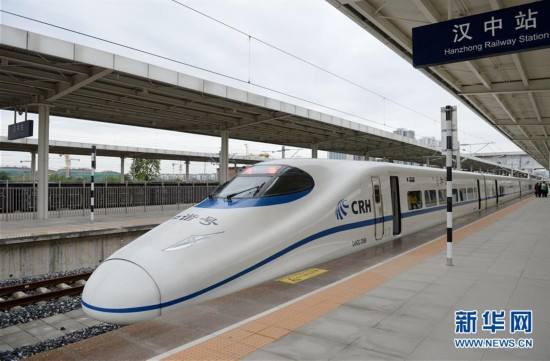
This year, more than 60 percent of Chinese have chosen high-speed trains to get them home for the Spring Festival, Chinanews.com reported on Feb. 13.
High-speed trains have made travel easier and more comfortable. “Before, it took me 16 hours by train to get home, and because of that, I could only go home twice at year, at most,” said a passenger surnamed Zhang, who comes from Chengdu and works in Xi’an.
The opening of the Xi’an-Chengdu High-speed Railway has cut travel time between the two cities to around three hours, enabling Zhang to go home twice a month.

The total mileage of China’s high-speed railway network has reached 25,000 kilometers. With the operation of the Baoji-Lanzhou, Xi’an-Chengdu, Shijiazhuang-Jinan high-speed railways, more people will, for the first time, return home for the Spring Festival by high-speed trains like Zhang.
“With high-speed trains, I can embark on a train from Beijing in the morning and get home in the evening,” said a passenger surnamed Liu, who comes from central China’s Hunan province and works in Beijing.
A person with China Railway disclosed that more than 5,600 high-speed trains will serve every day during the Spring Festival travel rush, accounting for 65 percent of the total number.



 Fire brigade in Shanghai holds group wedding
 Tourists enjoy ice sculptures in Datan Town, north China
 Sunset scenery of Dayan Pagoda in Xi'an
 Tourists have fun at scenic spot in Nanlong Town, NW China
 Harbin attracts tourists by making best use of ice in winter
 In pics: FIS Alpine Ski Women's World Cup Slalom
 Black-necked cranes rest at reservoir in Lhunzhub County, Lhasa
 China's FAST telescope will be available to foreign scientists in April
 "She power" plays indispensable role in poverty alleviation
 Top 10 world news events of People's Daily in 2020
 Top 10 China news events of People's Daily in 2020
 Top 10 media buzzwords of 2020
 Year-ender:10 major tourism stories of 2020
 No interference in Venezuelan issues
 Biz prepares for trade spat
 Broadcasting Continent
 Australia wins Chinese CEOs as US loses



 久久99热播精品免费